Ever felt a burst of flavor from a tiny fruit juice pearl? It’s like magic on your tongue. But what if I told you it’s not magic, just molecular gastronomy home techniques you can master?
You might think this sounds like something only for chefs with fancy kitchens. It’s not. It’s a creative way to transform your regular cooking into something extraordinary.
I’ve spent countless hours (and made a mess or two) experimenting to bring you simple steps that work.
You’ll learn how to bridge professional techniques with what you have at home. It’s easier than you think. By the end of this, you’ll see cooking through a new lens.
Curious? You should be. This guide promises to demystify and excite, making the complex world of molecular gastronomy accessible and fun.
What is Molecular Gastronomy? (Hint: It’s Not Scary)
Molecular gastronomy sounds intimidating, right? I promise, it’s not. It’s the art of understanding how ingredients behave and using that knowledge to spin out new textures and flavors.
Think of it like baking. You know how yeast makes that bread rise? In molecular gastronomy, you learn how sodium alginate can create a gel, turning a liquid into a solid sphere.
Magic in the kitchen, if you ask me.
Now, let’s debunk a myth: it’s not all chemicals, smoke, and liquid nitrogen. Most “chemicals” are natural, like agar-agar from seaweed. It’s like comparing a science experiment to a magic show.
Sure, there’s flair, but the heart of it is understanding the science. The goal? Boost your dining experience.
It’s about surprising textures and intense flavors that turn meals into unforgettable moments.
So why should you care at home? For starters, it elevates simple dishes into something spectacular. Imagine impressing guests with a dish that looks like it belongs in a Michelin-starred restaurant.
You get to understand cooking on a deeper level. Every dish becomes a canvas for your creativity. It’s not just about feeding folks; it’s about telling a story through food.
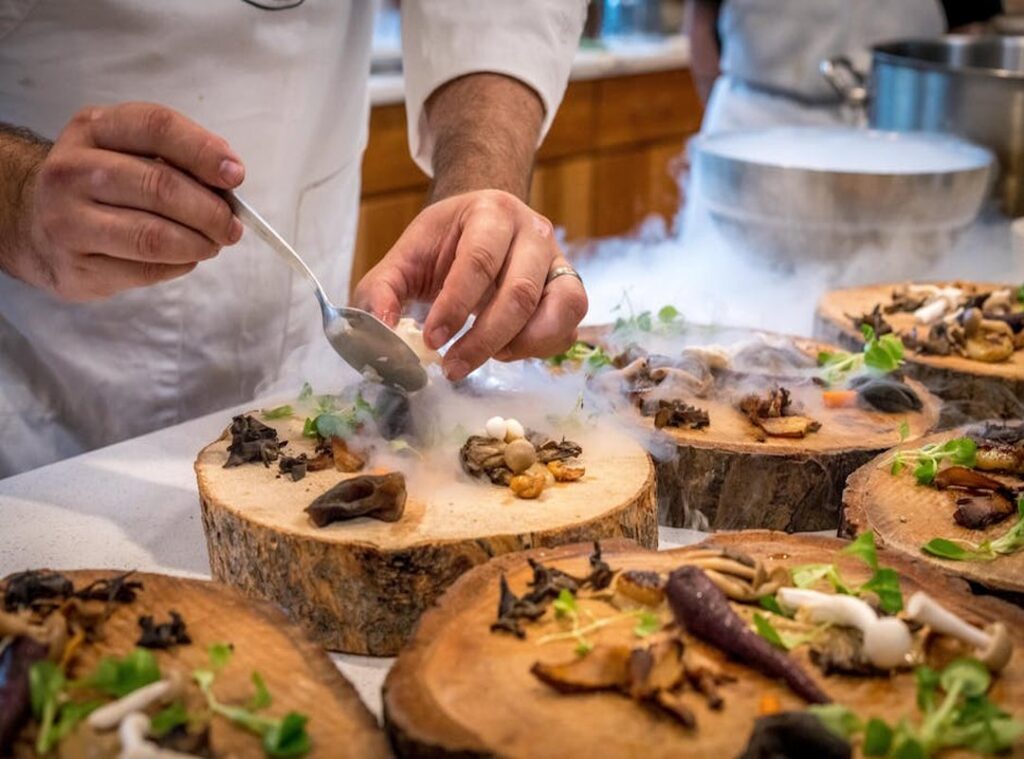
Curious about the art cooking liquid nitrogen? It’s one of the many techniques you can explore. Molecular gastronomy at home isn’t just about creating Instagram-worthy dishes.
It’s about pushing boundaries and having fun in the kitchen. So why not dive in and see what culinary wonders you can create?
Spherification: Pop Your Flavor Game
to spherification, a technique that’s both iconic and easy to start with. It sounds fancy, but trust me, it’s not rocket science. It’s just sodium alginate mixed into your flavorful liquid.
When you drop it into a calcium chloride bath, a thin, gel-like skin forms around it. This simple reaction is the magic of molecular gastronomy at home.
For beginners, reverse spherification is your friend. Why? It’s forgiving.
A perfect start is using yogurt, which is calcium-rich. Take mint and yogurt spheres, for example. Mix your sodium alginate with yogurt, let it rest (don’t rush), and then gently drop it into the calcium bath.
That’s it.
You’ll need a few things: an immersion blender, sodium alginate, calcium chloride, a digital scale, and two bowls. None of these are bank-breakers. Get them, and you’re ready for your first culinary science experiment.
Now, here’s the deal: let the alginate mixture rest to remove air bubbles. Nobody wants lumpy spheres. Use a rounded spoon for that perfect shape.
And rinse the spheres gently to keep them intact.
The sensory payoff is incredible. When you bite into these spheres, they pop and release a burst of flavor. It’s like a little explosion in your mouth.
Imagine dropping these into a hot soup, placing them on top of a fresh salad, or even using them as a garnish for a spicy curry.
If you’re intrigued by this, there are easy molecular gastronomy tricks that can raise your kitchen game without much fuss.
So, why wait? Dive into the world of molecular gastronomy at home and impress your taste buds (and your friends). It’s not just cooking; it’s creating edible art that pops.
Technique #2: Culinary Foams – The Art of Capturing Air
Ever heard of culinary foams? They’re a nifty way to pack intense flavor into dishes without weighing them down. Imagine biting into a light cloud that explodes with taste.

It’s the stuff of molecular gastronomy home experiments, right in your kitchen. How do we achieve this magic, you ask?
Well, it all starts with a stabilizing agent, like soy lecithin. You mix it with a flavorful liquid. When you agitate it with something like an immersion blender, it traps air bubbles.
The result? A beautiful, airy foam.
Let’s get practical. Suppose you want to whip up a Parmesan foam. Grab some Parmesan broth, a pinch of soy lecithin, and your trusty immersion blender.
Pour your liquid into a wide bowl (you need space for the bubbles), blend it up, and voilà! You’ve got your ethereal cloud of flavor.
Here’s a pro tip: keep your immersion blender tip at the surface. the magic happens.
Equipment-wise, you don’t need much. A flavorful liquid is key, maybe a stock or strained juice. Soy lecithin is your secret weapon, and the immersion blender ties it all together.
No fancy canisters required here.
Now, where do you use this foam? Simple! Spoon it over grilled fish, let it melt into a creamy risotto, or add a layer of complexity to roasted veggies.
It’s all about that burst of aroma when the foam meets heat.
Got a thing for new flavors? You might want to use smoking guns flavor enhancement to take your culinary adventures even further. The possibilities are endless, but remember to experiment.
That’s half the fun!
Sous Vide Magic: Precision in Cooking
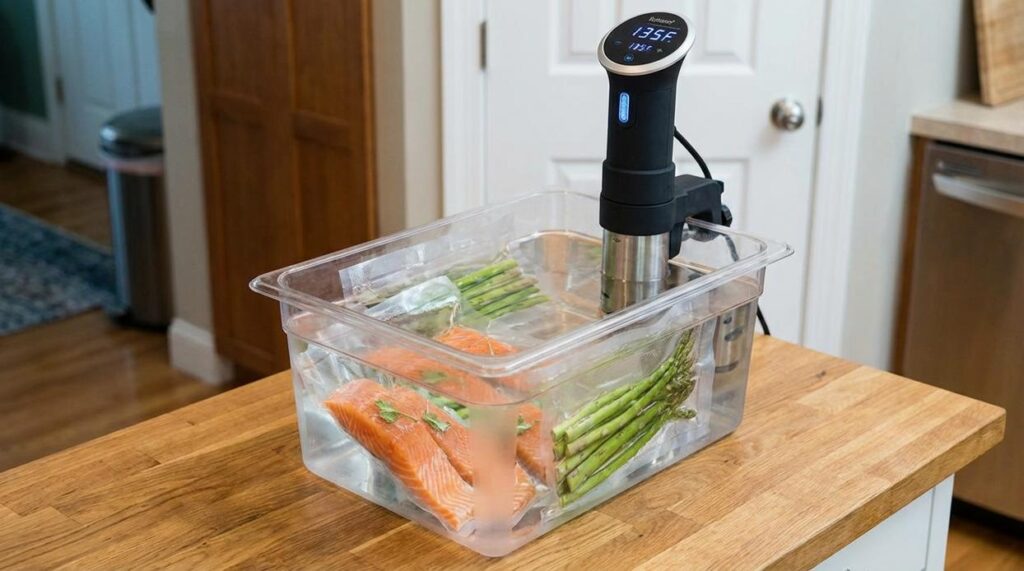
Ever tried sous vide? It’s a game-changer. For those of us diving into molecular gastronomy at home, sous vide offers a taste of the future.
Imagine sealing food in a bag and letting it bathe in a controlled water bath. Sounds fancy, right? But it’s simple and wildly effective.
Why bother, you ask? Because it’s about precise control. You get textures and consistency you can’t achieve with other methods.
Plus, those herbs and spices? They penetrate deeply, infusing every bite with flavor.
No more overcooked steak edges or dried-out chicken. The results? Perfect edge-to-edge cooking.
Let’s talk gear. You need an immersion circulator. It’s the heart of sous vide.
Then, choose your bags. I recommend reusable silicone or vacuum-sealed ones. They’re reliable for beginners and pros alike.
Ready for your first experiment? Try a perfectly cooked chicken breast or a 63°C egg. Both are easy and showcase sous vide’s magic.
You’ll wonder how you ever cooked without it.
Isn’t it time to raise your kitchen game? Dive into sous vide and embrace precision. It’s not just cooking; it’s an experience.
And trust me, once you start, you won’t look back.
Ignite Your Cooking Passion
Feeling like advanced cooking techniques are just for pros? Think again. You’ve got three solid techniques to start your molecular gastronomy home journey.
It’s not magic (it’s) science broken into easy steps. You’ll taste the difference, trust me.
Now, what’s stopping you? Pick one technique, grab those simple ingredients, and experiment this week. Don’t just dream about elevating your cooking (do) it.
Cooking shouldn’t be intimidating; it should be exciting. Ozvelex has your back. Dive into this delicious world and transform your kitchen into a playground.
Ready to impress yourself and others? Start today.
 Torvessa Druvina writes the kind of tutorial treasures content that people actually send to each other. Not because it's flashy or controversial, but because it's the sort of thing where you read it and immediately think of three people who need to see it. Torvessa has a talent for identifying the questions that a lot of people have but haven't quite figured out how to articulate yet — and then answering them properly.
They covers a lot of ground: Tutorial Treasures, Recipe Optimization Hacks, Ozvelex Fusion Cuisine Experiments, and plenty of adjacent territory that doesn't always get treated with the same seriousness. The consistency across all of it is a certain kind of respect for the reader. Torvessa doesn't assume people are stupid, and they doesn't assume they know everything either. They writes for someone who is genuinely trying to figure something out — because that's usually who's actually reading. That assumption shapes everything from how they structures an explanation to how much background they includes before getting to the point.
Beyond the practical stuff, there's something in Torvessa's writing that reflects a real investment in the subject — not performed enthusiasm, but the kind of sustained interest that produces insight over time. They has been paying attention to tutorial treasures long enough that they notices things a more casual observer would miss. That depth shows up in the work in ways that are hard to fake.
Torvessa Druvina writes the kind of tutorial treasures content that people actually send to each other. Not because it's flashy or controversial, but because it's the sort of thing where you read it and immediately think of three people who need to see it. Torvessa has a talent for identifying the questions that a lot of people have but haven't quite figured out how to articulate yet — and then answering them properly.
They covers a lot of ground: Tutorial Treasures, Recipe Optimization Hacks, Ozvelex Fusion Cuisine Experiments, and plenty of adjacent territory that doesn't always get treated with the same seriousness. The consistency across all of it is a certain kind of respect for the reader. Torvessa doesn't assume people are stupid, and they doesn't assume they know everything either. They writes for someone who is genuinely trying to figure something out — because that's usually who's actually reading. That assumption shapes everything from how they structures an explanation to how much background they includes before getting to the point.
Beyond the practical stuff, there's something in Torvessa's writing that reflects a real investment in the subject — not performed enthusiasm, but the kind of sustained interest that produces insight over time. They has been paying attention to tutorial treasures long enough that they notices things a more casual observer would miss. That depth shows up in the work in ways that are hard to fake.